


|
|||||||||||
|
|
|
|
|
|
|
|
|
|
|
|
 |
 |
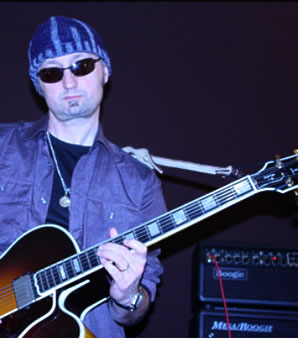
opium | mural | nine wings | state of the union 2.001 | CIMPos. Vol.7 | CIMPos. Vol.3 | JAZZ FM View Liner Notes In English Liner notes Mural, Bruce Eisenbeil's Crosscurrent Trio [English] Written by Marc Chaloin (1999) Translated by JF Delannoy(Feb. 2001) Of all the instruments appropriated by jazz in the constitution of a specific tradition, guitar has long been viewed as one of the less prone to a radical internal change of its idiom by the seeds of a radical evolution. On the contrary, the number of impeccable exponents endlessly refining its particular "poetics" seemed to earmark it for a kind of immobile perfection, enclosed in the certainties of a quiet conservatism unaffected by the questionings of the rest of the jazz sphere. So the main line of attack had to come from outside: the electric revolution of rock, exemplified by Jimi Hendrix and his transfiguration of the related language of urban (rhythm &) blues. After a generation of guitarists had rushed into the fusion-style breach opened in the wake of Jimi by Larry Coryell and John McLaughlin, a new balance appeared between the traditional "purist" use of the instrument and its moderns derivatives, accomplishing the increasing integration of amplification and electronics. This is how a new norm of legitimacy for jazz guitar, personified above all by Pat Metheny, superposed itself onto the former one, without upsetting its internal arrangement. And here comes a 36 years old guitarist who has only recently emerged from the anonymity of a long apprenticeship, to remind us that there are other possible courses on the six-stringed instrument, outside of the lit roads but without necessarily making a clean sweep of jazz foundations. Bruce Eisenbeil came of age in the circuit of small clubs, dance halls and weddings across New Jersey between New York and Philadelphia. His initial self-taught approach of the guitar did not dissuade him later to study it further with several masters, famous or not, from a certain Harry Leahey to Pat Martino, Joe Pass and Joe Diorio. But even his two-year immersion in the Musicians' Institute, a Californian factory of homologated technicians, did not undermine his desire to exist musically on his own terms rather than conforming with criteria imposed by the industry. Though he mentions Wes Montgomery as his dominant model for improvised developments -- main theme, single-note chorus, double-stop chorus, chord chorus, and back to the theme --, Bruce's musical universe cannot be reduced to strictly guitaristic dimensions. In fact he deliberately stopped listening to other guitarists in 1987. A significant sign of this is his choice of Dennis Sandole as his genuine mentor: the Philadelphian - whose teaching Eisenbeil is still following - who had prepared the young John Coltrane for his enterprise of methodical reexamination of the harmonic and melodic materials of jazz. He has been contributing for a dozen years to the birth of a new generation of improvisers-composers interested in always pushing back the boundary between advanced tonal harmony and pure atonality, like Matthew Shipp or the saxophonist Rob Brown (who was part of Bruce Eisenbeil's superb first CD Nine Wings -- CIMP 144). The Crosscurrent Trio had only been a few months in existence - and intensive practicing - when it recorded the nine tracks of Mural for CIMP. Two newcomers side with the guitar: J. Brunka, the acoustic bassist, born in 1973 in Brooklyn, and Ryan Sawyer, the drummer, 23, freshly arrived from his native Texas, had been playing together in Upstate New York before their common friend the multi-instrumentalist Daniel Carter brought Bruce and Ryan in contact. In their first musical encounter, which was totally improvised, the three immediately felt in tune. But strangely the music prepared by Eisenbeil only took shape in two stages and two different duos (guitar/bass and guitar/drums) -- a gradual and concentric approach, which is probably the reason why there is nothing loose in the interlocking of the three voices, in spite of the liberty left to their respective parts. Eisenbeil, who uses a Fender Stratocaster with tight strings and very little amplification, favors a natural, spare sound, with no reverberation and almost metallic. His mastery of note production and resonance, his frequent recourse to tremolo and other nuances are redolent of the art of great blues musicians and maybe, more fugaciously, of the one of Indian sitar players, as an indirect confirmation of his proclaimed admiration for John Coltrane. Like him he can make the best out of the repetition-variation of short motives which he releases in long melodic perspective lines, fluid or more hashed constructions, sometimes resolved in bunches of thin sonic particles. But the most fascinating is the density of his polyphonic playing, constantly varied, as it superimposes over the classicism of a Wes Montgomery tensions which generate a generalized harmonic relativism, drawing a lot upon dissonants chords and all types of clusters. Nothing is more remote from the spirit of this music than the will to establish a hierarchy between a soloist in the foreground and his accompanists. The three instrumental voices are constantly perceived as operating in a space of contiguity which is at the same time a continuity - of flux, texture, and vibration amplitude - achieving a purposeful particular presence in the sonic events as their particular form unfolds. Bruce Eisenbeil explains: "The intervals between the guitar and the bass are used to get maximum resonance. As the compositions were being developed, I began to recognize the "spirit creature" in their architecture. We improvise on the movements of every spirit. I do not compose according to a technique or a learned formula; the decisions are made by my ear. I have no formal education, so the music I invent is based on how I like to hear it and how it develops dramatically." This is an acknowledgement of a principle inherent in the music, the moving spirit of each every composition, in front of which the three musicians find themselves on an equal standing of initiative and response, having internalized its basic elements like themes, scales, range, speed, etc. Ryan Sawyer has studied the "ways of music" with Bobby Previte and Thurman Barker, but here he evolves in the hectic trails jointly opened since the 60's by Sunny Murray, Milford Graves, Rashied Ali, Steve McCall and some of their American and European disciples. He is skilled at thwarting expectations, and uses a percussion both aerial and dense, energetic and seething, generating on all the levels of the acoustic spectrum halos and vibrations propagated in multiple wavefronts between the skins and cymbals. J. Brunka belongs to a generation of young acoustic bassists with full technical credentials, whose natural field of expression is enriched, downstream from Charlie Haden or Fred Hopkins, by the now inevitable contribution of a William Parker. The sound depth and the supple firmness of his articulation and phrasing, the prominent use of pizzicato in the low range (and more bowing in the medium and upper ranges), the economy, define a playing whose binding and embracing qualities are essential for the cohesion and the integrity of trio's music. At every moment of its ever-evolving course, the intimate mix of the harmonic components of the sounds exceeds and supersedes their functional surface relations (pitches, values, etc.). This is a way to take into account the whole of the sonic phenomenon which gives all its meaning to the connection which Eisenbeil makes, with dedications and cross-references, between different facets of a convergent musical "modernity": Stravinsky, Coltrane, Penderecki, Bill Dixon... Because it participates in this continuity, the music of the Crosscurrent Trio is also inscribed in the most vivid reality of a jazz which everywhere tends to drown in acoustic indifference or find itself cornered in identity representation. As expressed more directly by Bruce Eisenbeil himself: "In my youth I learned traditional jazz tunes and ideas, then I found other intervals I liked more... I really appreciate the heritage of guitar music and the way it relies on the touch of the instrument as expressed by past masters of jazz. I enjoy the traditional though I prefer the new." On the plane of tonal organization, this corresponds to the intensive recourse to materials and techniques used only superficially as procedures by jazzmen. Wildflowers is based on a twelve-tone scale spanning two octaves and a half: E, Bb, C, Db, Eb, G, Ab, B, D, F, Gb, A. The atonal character of this "series" is made compatible with a jazz treatment by a parallel chromatic approach, while the unique proportions of the melodic themes induce the equilibrium and overall symmetry of the piece. Worth noting is also the use of ample polymodal chords and of double-stops in contrary movement. Caesar draws largely upon the resources of polytonality and polymodality by exploiting simultaneously three distinct tonalities: E major (Ionian), G minor (Dorian) and Bb minor (Phrygian) as the basis of the themes and the harmony. There are classical examples of polymodal writing in works like Bartok's Third String Quartet, Ravel's Piano Concerto in G, Stravinsky's "Oedipus Rex" or Messiaen's "Vingt Regards Sur l'Enfant JŽsus", but Eisenbeil finds more direct inspiration in the Coltrane of the last period, from Ascension on. Yet, whereas Coltrane assigned a different mode to every instrument, Bruce brings up several voices simultaneously. His chord choruses (composite chords obtained by superposition/combination of various intervals) correspond to the art of McCoy Tyner, while Woman With A Handful Of Rain is another piece loaded with references to Coltrane's universe. Habeas Corpus is dedicated to Bill Dixon, the gray eminence of another side of jazz modernity, and is preceded by a short solitary guitar episode constituting a richly concentrated premonition of what is following. From a material of altered diminished scales the guitarist extracts themes organized in tetrachord spans containing three, four or five notes, the combination of this tetrachords producing in turn the harmony. The theme, played on a different string at each of its expositions, is heard successively in the alto, tenor and bass range of the instrument, dressed each time in a new harmonic variation. It is thus harmonized in six distinct ways during the guitar's chord choruses. Christ v. Paradise reintroduces a more bluesy feeling, while exploring wide intervals. It is from blues guitarists and pianists that Eisenbeil has learned his tremolo technique - popularized in jazz guitar by Django Reinhardt - which he applies lavishly in In Memory of A.D. Rhythmical organization goes here to the background, starting with the introduction itself where the guitar moves in three-note series against the five-note series played by the bass and the drum set. At the other end of the spectrum of Eisenbeil's musical interests is the extraordinary Crucifixion, which refers to the sphere of Western sacred music, in its traditional aspects as well as in its contemporary elaborations, especially by the Polish composer Krzysztof Penderecki. The desolate melodies spelled by the guitar (inspired by Luc 23 : 33-46) are written in Gregorian plainsong with no indication of rhythm. The latitude of interpretation this leaves fosters the dramatic intensification of individual expression. In keeping with the somber climate of the composition, J. Brunka has lowered by one tone the low E of his acoustic bass in order to reach at the deepest of his range with his superb bowing. Pitches do not follow any given scale, even though a certain chromatic alteration of diminished scales is reminiscent of Bela Bartok's last string quartets. They mainly reflect Eisenbeil's feelings and his permeability to the influence of the Latin mass, besides the religious music of Penderecki and Stravinsky. Yet this beam of parallel musical worlds is not his only source of inspiration; Blue Poles is named after a Jackson Pollock painting whose sequence or layers Bruce has followed: black, white, aluminum, orange, yellow, black and blue. After defining his own color scales -- or used Messiaen's when possible -- he extracted the themes and chords. This piece is performed as if the musicians themselves were engaged in action painting. Mural is not merely signaling the emergence of a new state of the language of jazz guitar; it is a milestone in the continuous renewal process of this music as a whole from its avant-garde pole, which more than ever today is shaping up as the only viable alternative to the aesthetic lock-up by the would-be exclusive custodians of its tradition. Marc Chaloin, April 1999 |